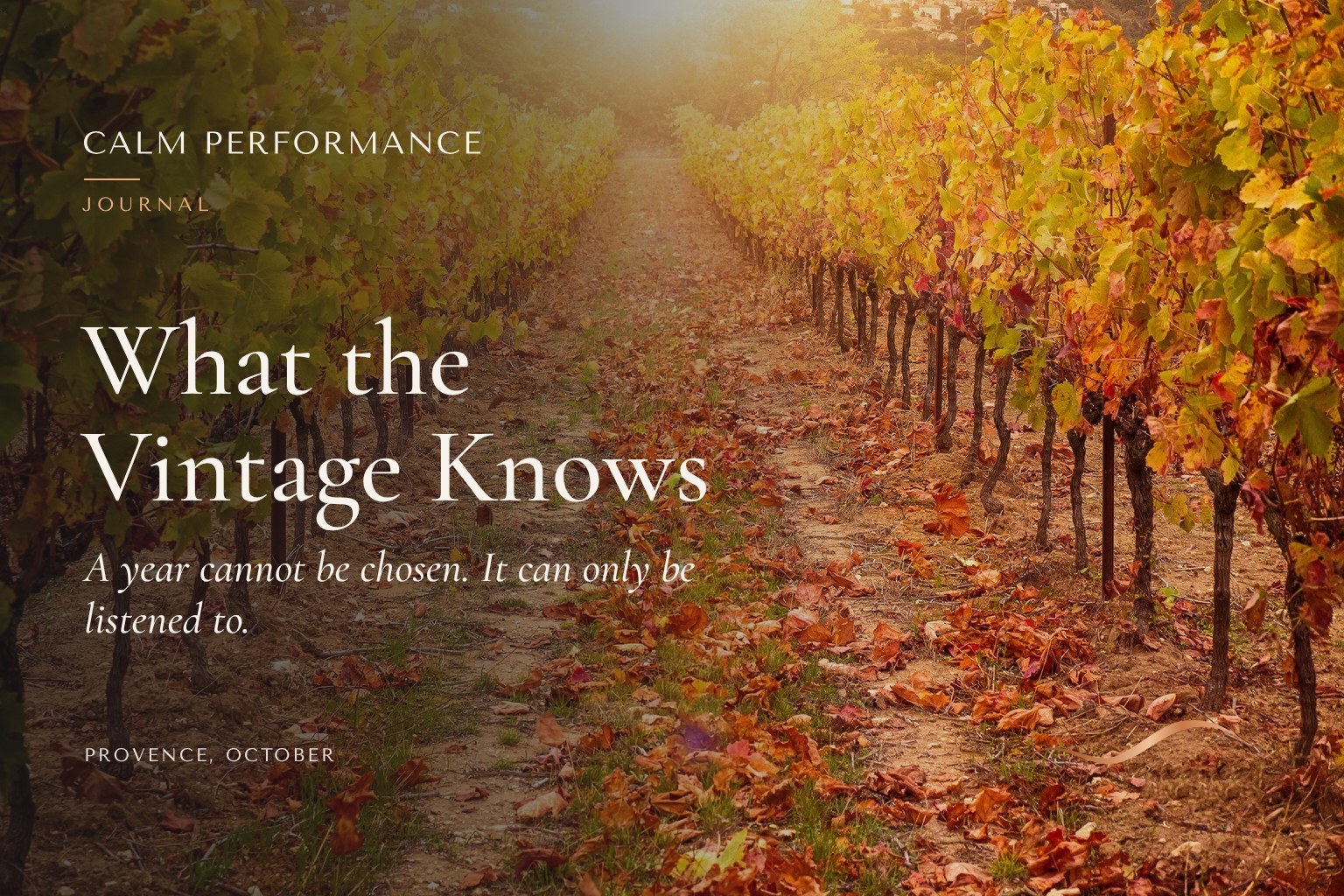
In Provence in mid-October, a row of vines after the harvest feels like a room someone has just left. The vines are still there, two tidy lines running away towards the far end, but the grapes are gone. The leaves have turned: a few are still green, many have gone yellow, orange, rust red. The fallen ones cover the earth between the rows like an uneven carpet. At the far end, low on the horizon, the sun slants in and sets everything glowing with a warm light, almost the colour of embers.
Anyone walking through now has arrived late. The year’s work is done. The grapes are in the cellar, the wine is fermenting or resting in the vat, and nobody yet knows exactly how it will turn out. And yet the row already knows a great deal. It knows how much rain fell in spring, how hot the August sun was, when the first cold arrived. All of that is already written into the grapes that have left. It only remains to be read.
That is what every vintage is: the story of a year that could not be chosen, only lived through.
An archive of harvests
In Beaune, in Burgundy, someone wrote down for centuries the date on which the harvest began. Not out of love for science, but for practical reasons: the pickers had to be paid, and the wage records kept the day picking started. In 2019 the historian Thomas Labbé and a team of researchers gathered those documents and drew from them an almost unbroken series running from 1354 to 2018. To check how reliable it was, they compared it with the Paris temperature record, kept since 1659. The results were published in the journal Climate of the Past.
It is one of the longest climate archives in Europe, and it tells a simple story. For more than six centuries, until 1987, the harvest in Beaune began on average around 28 September. In the last thirty years of the series it began on average on 15 September, almost two weeks earlier.
But the most interesting thing about the archive is not the average. It is the difference from one year to the next. There are vintages when picking started at the end of August and others when it waited until October. Each date is the trace of a different year: a cold spring, a scorching summer, a wet September. No grower in Beaune ever decided when the moment would come. All they could do was recognise it.
Two kinds of excellence
There is another idea of excellence too, and it deserves its due. In Champagne, most bottles carry no year on the label. They are non-vintage: each house blends wines from different years, including reserves set aside in earlier seasons, to achieve the same style every time. It is a real art, and a difficult one. Its aim is to make variation disappear, so that whoever opens a bottle today finds the same taste as ten years ago.
Vintage Champagne is something else. It is made only in years judged exceptional, from the grapes of that single harvest, and must age for at least three years in the cellar before it can be sold. It is not trying to resemble anything. It is trying to say, as faithfully as it can, what that year was like.
The two are not in competition. But they describe two different ways of thinking about work. In the first, excellence is consistency: the same result, whatever happens. In the second, excellence is attentiveness: the best possible result within what actually happened. Our working culture knows the first extremely well. It often forgets the second.
The year you do not choose
In 1961 the Bordeaux vintage got off to a bad start. After a rainy winter and a mild February, the vines flowered early, on 12 May. Then the cold came back. On 29 May a frost struck the vineyards at the most delicate moment, just as the flowers were turning into berries. Many never formed, a failure growers call coulure. At Château Latour, in Pauillac, around three quarters of the crop was lost. July was cool and wet. It looked like a year to forget.
Then, from late August, the weather turned. Weeks of steady sunshine, never excessive, right up to the harvest between 19 and 28 September. The few bunches that remained ripened slowly and fully. The 1961 became one of the legendary vintages of the twentieth century: concentrated, deep wines, capable of ageing for decades. When the English critic Michael Broadbent tasted the Latour in 1968, he gave it six stars, one more than the top of his own scale.
It was not in spite of the frost. It was, in part, because of it. Fewer bunches meant more concentration in the ones that survived. The hardship of spring became the character of the wine. It was something no planning could have produced, and something no grower would ever have chosen.
The art of waiting
What, then, does a good grower do, if the year cannot be chosen? Émile Peynaud devoted his life to that question. Born in Madiran in 1912 and dying near Bordeaux in 2004, he is widely regarded as the father of modern oenology. His experience is gathered in a book that became a classic, Le Goût du vin.
One of his most important contributions sounds almost obvious. He persuaded many Bordeaux châteaux to pick later, sometimes as much as two weeks after their usual date, and to reject unripe or damaged grapes. For centuries the harvest had begun when the calendar said so, or when fear of bad weather advised it. Peynaud taught growers to pick when the grapes said so.
It is a very precise kind of patience. It does not mean waiting around doing nothing. It means tasting the berries every day, measuring the sugars, checking the colour of the pips, watching the sky, and then deciding. Sometimes it means risking the rain to gain three more days of ripening. Sometimes it means picking early, because the weather is about to break. The skill lies not in imposing a rule on the vineyard, but in knowing how to listen to it.
When the rules change
Another archive tells a subtler story. In 2016 the climate scientist Benjamin Cook, of Columbia University and NASA, and the biologist Elizabeth Wolkovich, of Harvard, studied four centuries of harvest dates in France and Switzerland. Their paper in Nature Climate Change showed that for a long time an early harvest was the sign of a hot, dry summer. And hot, dry summers, as a rule, gave good vintages.
It was a rule growers knew without ever having written it down. But from 1980 something changed. Harvests kept getting earlier, but no longer needed drought to do so: the heat now arrives regardless. The link between the two had come apart. In 2003, the year of the great European heatwave, the harvest was the earliest in the entire record. The wines of that vintage, however, were of very uneven quality.
The lesson goes beyond wine. Even the signals that seemed most reliable can stop working. Those who work from a fixed recipe notice too late. Those in the habit of reading each year’s conditions notice sooner that something has shifted. Real expertise is not knowing the rule, but noticing when it no longer applies.
The same thing happens to us. A method that worked for years with a client, a colleague or ourselves eventually stops delivering the same results. The temptation is to persist, to apply it harder. The attentive grower does the opposite: goes back into the rows, tastes, and starts looking again.
A response, not a recipe
Ticino has its own story of unforeseen conditions. At the end of the nineteenth century phylloxera, a tiny insect that had arrived from America, destroyed the roots of vines across much of Europe, and here too. The traditional vineyards disappeared. Growers had to start again almost from scratch.
The answer came in 1906, when the first Merlot cuttings, a Bordeaux variety, were handed out. Among the decisive figures was Alderige Fantuzzi, who ran the canton’s travelling agricultural advisory service. He did not discover Merlot, but he was among the first to see that it suited Ticino’s climate and soils. The new vines were grafted onto American rootstocks that could resist the insect. Today Merlot is the wine the canton is known for.
It is a story of excellence born from catastrophe. Nobody wanted phylloxera. But those who rebuilt Ticino’s vineyards did not try to turn back the clock. They looked at the conditions in front of them and searched for what, within those conditions, could work best.
Working with the vintage
At this journal, Calm Performance is our name for a way of working that judges performance partly by what it manages to preserve: energy, attention, clarity. A vineyard shows one way to waste them: insisting that every year be the same as the last. That every project start from the same conditions, that every team respond in the same way, that every season of life offer the same possibilities. It is an exhausting demand, because it collides with reality every time.
A few simple choices follow. The first: at the start of every project, ask what this year’s conditions are, not last year’s. The resources, the people, the context, the time available. The second: taste often. Like Peynaud among the rows, check at short intervals how things really stand, rather than trusting the calendar. The third: do not mistake difficulty for failure. A spring of frosts can produce a legendary vintage, if you work well with what remains.
And a fourth, perhaps the most important: revise your own rules from time to time. The ones that have worked for years are not eternal. On the day the heat arrives without the drought, anyone still reading the old signals will pick at the wrong moment.
What the vintage knows
Back to the October row. The leaves keep falling, one at a time, and in a few weeks the vines will be bare. Before it falls, each leaf has handed back to the plant part of what it had built up: sugars and nutrients that the vine stores in its wood and roots, a reserve for the year ahead. The red and gold of the row is that too, a handing over. The leaves on the ground will break down and return to the soil. In winter the vine will rest. In spring it will begin again, with no idea what kind of year awaits it.
It will be different from this one. Wetter, perhaps, or hotter, or with a frost at the worst possible moment. The grower will not be able to choose it. All they can do is watch it closely, day after day, and respond as precisely as they can.
Perhaps that is what the vintage knows, and what we sometimes forget. That excellence is not the elimination of variability. It is the precise and patient response to it. And that every year, even the hardest, brings with it something no other year could have given.