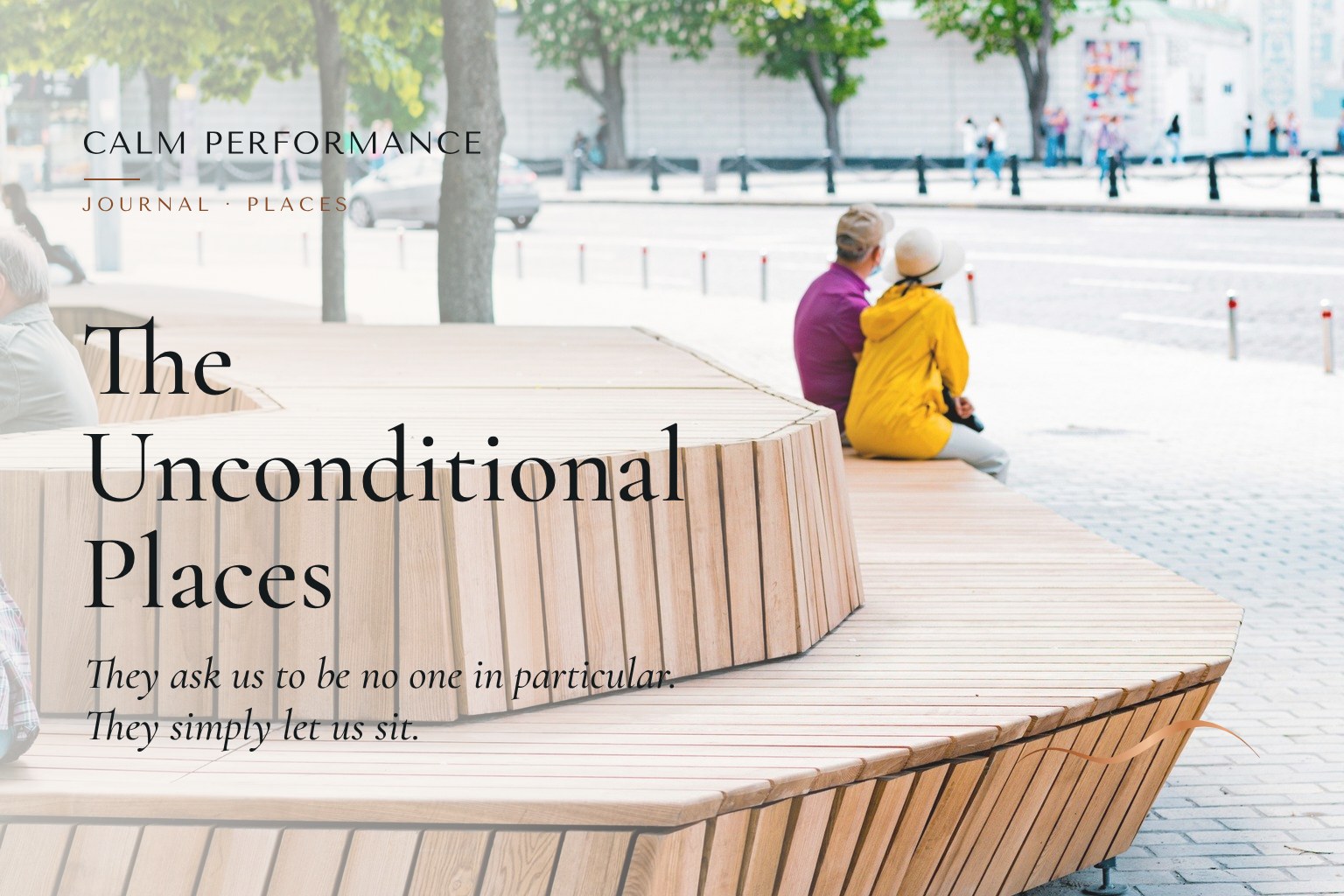
In a city square, under the trees, the town makes its usual noise: a car going by, footsteps on the paving, someone calling from further off. Beneath the branches runs a long wooden bench, pale slats folding back on themselves like a path. A man has sat down at one end, watching nothing in particular. Further along, two people, he in a cap, she in a yellow raincoat, sit close together looking out at the street. Nobody put that bench there to be looked at. It is there for whoever turns up.
Whoever sits down has nothing to do. No need to introduce yourself, order something, explain why you came. There is no ticket, no opening hours, nobody asking whether everything is all right. You can stay two minutes or an hour, with a book or with your hands in your pockets, happy or worn out. The bench does not notice.
It is a small thing, almost trivial. And yet, when you think about it, very few places in an ordinary day work like this. Nearly all the others, one way or another, ask for something in return for our presence.
Front stage, backstage
In 1956, in Edinburgh, a young Canadian sociologist published a book that would change the way we look at everyday life. His name was Erving Goffman, and the book, The Presentation of Self in Everyday Life, began from a simple idea: in public, we perform. Not in the sense that we lie, but in the sense that whenever someone is watching, we manage the impression we give. The tone of voice, the clothes, the way we sit, even the arrangement of the furniture in an office: all of it contributes to a performance.
Goffman distinguished two regions. There is the front, where we present ourselves to others and keep up our role. And there is the back region, the backstage, where we can prepare for the role or set it aside: the restaurant kitchen behind the swing door, the changing room, the parked car before a job interview. Backstage you take off your jacket, sigh, and go back for a moment to being simply someone.
What is striking is how small the backstage has become for many of us. The office is front stage. Dinner with friends, in part, is too. The phone has carried the front stage all the way to the sofa at home: one notification is enough to make us feel watched, expected, assessed again. Few places remain where nobody is looking at us in order to judge. A bench in a park is one of them. It is a backstage in the open air, in the middle of everyone, where you can put your role down beside you like a bag.
A society that never sits down
Someone has put a name to the fatigue that comes from a front stage with no interval. In 2010 the philosopher Byung-Chul Han, born in South Korea and teaching in Germany, published a short essay that became a sensation: The Burnout Society. His argument is that today’s society is no longer one of discipline, of prohibitions and overseers, but one of achievement. Nobody forces us. We are the ones who keep demanding more of ourselves. And that is exactly why it is so hard to stop: the overseer and the overseen are the same person.
Han writes of an excess of positivity, of a can-do that knows no limits. The result, he argues, is not illness arriving from outside but exhaustion welling up from within. His pessimism is open to debate. But one thing he describes is easy to recognise: the logic of achievement has colonised rest as well. Sleep is tracked. A walk is counted in steps. A holiday is planned so that it will send us back more productive. Even meditation is sold as a way to get more done.
Useful rest is still performance, just in different clothes. That is why certain places are worth more than their scenery. A bench measures nothing. It does not log the time you spent, give you a score, or promise to send you back improved. It lets you sit, and that is all. In a world where almost everything has become an opportunity for self-improvement, a place that asks you to improve nothing is close to radical.
Where people sit
In the 1970s the urbanist and journalist William H. Whyte spent years with a team of researchers watching the plazas of Manhattan. They counted people, noted where they stopped, filmed how they moved. They wanted to understand why some public spaces were full of life while others, often more handsome and more expensive, stayed empty.
They tested every explanation: sun, aesthetics, shape, size. Each one had its exceptions. In the end, in the book that came out of the work in 1980, The Social Life of Small Urban Spaces, Whyte wrote a line that sounds obvious and isn’t: people tend to sit most where there are places to sit. A spectacular fountain or a bold piece of architecture draws nobody if there is nowhere to rest. Whyte had a soft spot for movable chairs. He noticed that many people, before sitting down, shifted them a few inches, even when there was no need at all: a small gesture to say that this spot, for the moment, was one they had chosen.
There is more behind this finding than advice on street furniture. A place to sit is an unconditional invitation. It does not require you to buy something, like a café table. It does not require you to belong, like a club lounge. It is one of the few pieces of a city that truly belongs to anyone. And wherever there is one, people stop: not because there is something to do, but because at last they can do nothing.
A piece of heritage
In Switzerland this invitation has a long history. As early as 1818, a public bench was set up at the Giessbach Falls on Lake Brienz for anyone who wanted to stop and watch the water. By the mid-nineteenth century benches had reached city parks, used mostly by a bourgeoisie with time to stroll. Today, all over the country, there are beautification societies, the Verschönerungsvereine, whose volunteers install and look after benches along footpaths, in woods and at viewpoints.
In Switzerland benches are regarded as cultural heritage, Swissinfo noted in 2018, the year the country’s programme for the European Year of Cultural Heritage even gave them a day of their own, the Bänkli-Tag. When some towns tried to remove a few to save money, residents stepped in. In Lucerne, around 2015, local painters and carpenters offered to maintain the city’s roughly thirteen hundred benches for free. In Winterthur some can be adopted, with a small dedication plaque.
There is something touching about this care. A country famous for efficiency, precision and trains that run to the minute defends, stubbornly, the most inefficient object there is: a plank of wood to sit on for no reason. Perhaps it is not a contradiction. Perhaps it is precisely those who know the strain of performance best who understand what a place that demands none is worth.
Less than a third place
In 1989 the American sociologist Ray Oldenburg published The Great Good Place, a book about what he called third places: not home, not work, but the café, the neighbourhood bar, the barber’s shop. Open, welcoming, unpretentious spaces where you need no invitation, where everyone is on the same level and there are regulars. For Oldenburg they were the fabric of civic life, and he feared they were disappearing.
Look closely, though, and third places still ask something of you. Oldenburg said so plainly: the main activity is conversation. You go to the bar to talk, to laugh, to argue. It is a gentle front stage, but a front stage all the same. You have to show up with your voice, your mood, at the very least a hello.
The bench in the square is less than a third place, and that is exactly what makes it different. It does not ask you to talk. It does not even ask you to be in a good mood. It takes in the silence of someone who doesn’t want to see anyone with the same indifference it shows two friends deep in conversation. It may be the last public space where you can be alone without your solitude becoming a problem to solve.
Witnesses
Over time, some of these places become ours. Not because anything extraordinary happened there, but because ordinary things happened there often enough. We sat there after a difficult phone call, on an afternoon without a care, on a day when we weren’t sure where to go. The bench remembers none of it. We do.
And that asymmetry has a curious effect. The place keeps no score, so it never holds us up against earlier versions of ourselves. It doesn’t tell us we were calmer last year, or younger, or further ahead. It takes us as we arrive, today. It asks for no continuity and no living up to last time. It is a rare kind of welcome: to be recognised without being measured.
The right to sit
At this journal, Calm Performance is our name for a way of working that judges performance partly by what it manages to preserve: energy, attention, clarity. Talking about performance in a piece that praises its absence may sound like a paradox. It isn’t. The people who work well for a long time are not the ones who never stop. They are the ones who know where to stop properly.
A few simple choices follow. The first: have at least one unconditional place, and know where it is. It might be a bench, a low wall by the lake, a corner of a church, a step in the sun. It doesn’t need to be beautiful; it needs to be close by and to ask nothing. The second: go there without a purpose. Not to think through a problem, not to do breathing exercises, not to switch off so you can come back more efficient. Bring a goal with you and the place stops being unconditional. The third: leave the phone in your pocket, at least for a while. It is the phone that carries the front stage everywhere.
And a fourth, more civic than personal: stand up for these places. Benches are removed quickly, to save money, to discourage people who use them too long, to make room for something else. Every time one disappears, a city becomes a little more front stage and a little less home.
The bench in the square
Meanwhile, in the square, the traffic keeps flowing past the bollards, and people cross without stopping. The two of them are still there, sitting close, facing the street as if waiting for someone, and waiting for no one.
Soon they will get up, and the city will carry on as before. The deadlines remain, the messages are still waiting, nothing has become any easier. And yet whoever gets up from that bench often leaves a little different. The place solved nothing. It simply stopped asking, for a moment.
Perhaps that is what unconditional places have always offered. Not a solution, not a reward, not a better version of ourselves. Just somewhere to sit without having to be anyone in particular. And enough quiet to remind us that beneath all the roles we play, there is still someone who has no need to perform.
The idea
There are places where no role has to be played, and that is where people recover. The more closely work is watched, the fewer of those places remain.
Read more: Trust and control