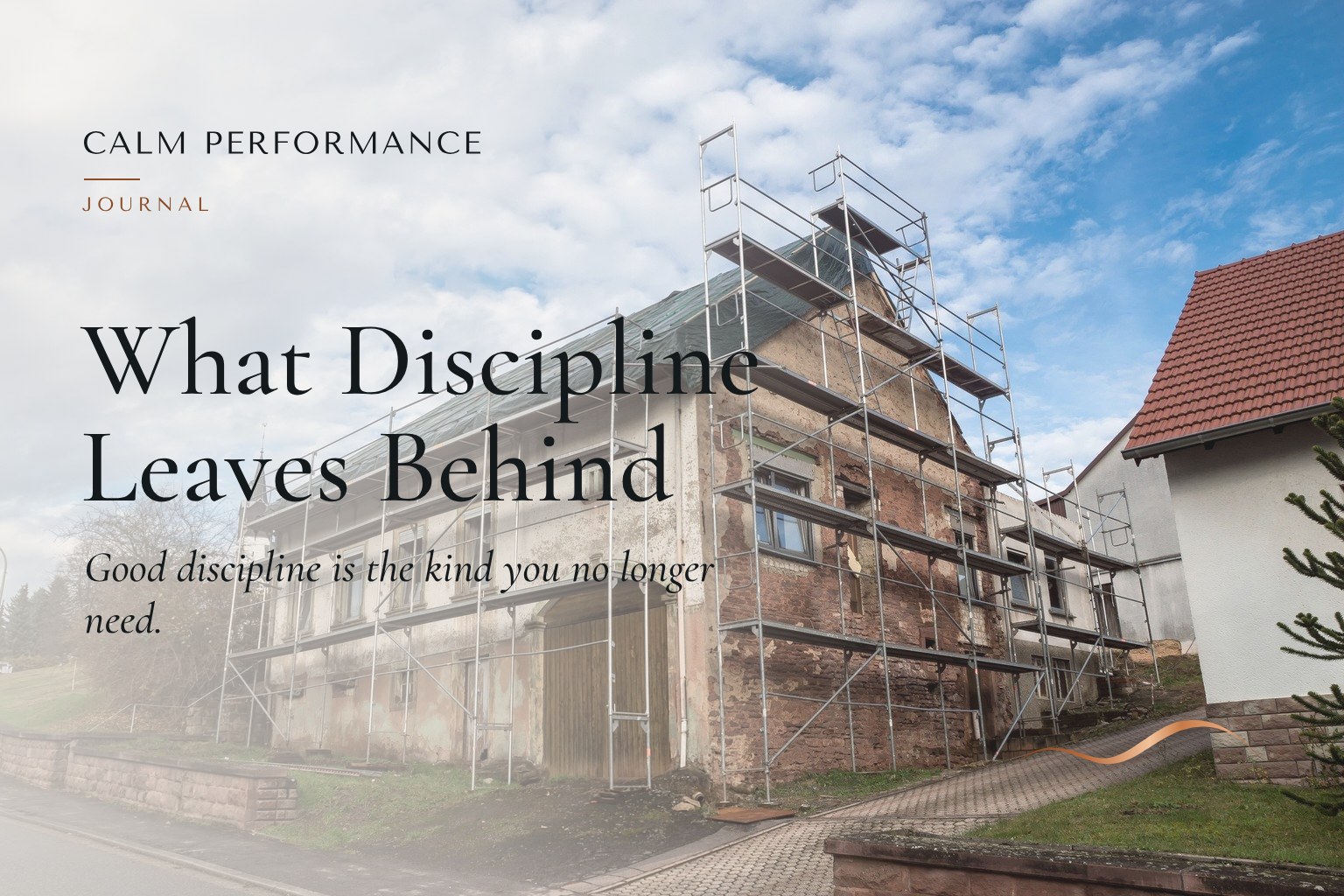
All summer, in the old centre of a village in Ticino, the Italian-speaking south of Switzerland, a stone house stood hidden behind scaffolding. Steel tubes, planks, green netting that billowed in the wind. That was all anyone saw: the site, the noise, an iron ladder propped against the wall. Of the house itself there was almost nothing to make out. Then, one October morning, the workers began taking it down, tube by tube, from the top. By noon the scaffolding was on the lorry, and in its place stood a clean façade, with new shutters and freshly scrubbed cornerstones.
That evening, people stopped to look. The house was beautiful, they said; it looked as if it had always been like that. Nobody mentioned the scaffolding. Yet without it no one could have reached the roof, replastered the walls or replaced the rotten beams. The scaffolding had made all of it possible. Its final job was to disappear.
Discipline works the same way. While you are practising it, it is all anyone can see: the early alarm, the things given up, the effort of starting over. Once it has done its work, it goes, and only what it built remains. From the outside, people see the façade and call it talent, or character, or luck. They rarely call it what it is: the work of a scaffold nobody remembers.
The scaffolding
We admire visible results. The published book, the healthy body, the business that holds together, the calm of someone who never seems rushed. We are far less curious about how people got there, because that part makes a dull story. It is made of days that look the same, small decisions repeated, evenings when the necessary thing got done without the faintest wish to do it.
But there is a subtler misunderstanding, and it belongs to the people who practise discipline themselves. We tend to picture it as a permanent condition: a daily fight against laziness, an act of will to be summoned every morning for the rest of our lives. Think of it that way and, sooner or later, you tire. And when you tire, you conclude you lack character.
Scaffolding suggests another idea. No builder puts it up to stay there forever. It goes up so that something can be built that will stand on its own. Successful discipline is not the kind that holds out longest. It is the kind that, at some point, is no longer needed.
Forty-three per cent
In the early 2000s the American psychologist Wendy Wood, who has spent decades studying habit, asked a group of people to record, every hour for several days, what they were doing, what they were thinking about and whether they were somewhere familiar. The results, published in 2002 with her colleagues Jeffrey Quinn and Deborah Kashy, were striking: around forty-three per cent of everyday actions were repeated almost daily, in the same place, while the mind was on something else.
Nearly half the day, in other words, runs itself. We brush our teeth, make coffee, take the same road, open the post, without deciding to each time. This is not a flaw. It is what frees our attention for other things: a problem at work, a conversation, an idea that turns up while we drive.
This is where discipline ends up when it works. What once took a decision and a little effort becomes, with enough repetition, one more thing we do without thinking. The six o’clock alarm stops being a battle and becomes simply the time you get up. The walk after lunch stops being a resolution and becomes the walk after lunch. Discipline has not faded through weakness. It has faded because it won.
Sixty-six days
How long does that take? In 2010 Phillippa Lally, a researcher at University College London, followed nearly a hundred volunteers, each of whom had picked a simple new habit: a glass of water with lunch, a piece of fruit, a fifteen-minute run before dinner. Every day for twelve weeks, they rated how automatic it had become.
The median time to get close to automatic was sixty-six days. But the more telling figure is the spread: depending on the person and the habit, it ranged from eighteen days to more than eight months. A glass of water became automatic long before exercise did. And missing the odd day made almost no difference; the curve simply picked up where it had left off.
There was also a detail of method that tends to be forgotten. Each participant tied the new habit to a fixed point in the day, always the same one: after breakfast, at lunch, before dinner. Repetition alone was not enough. It had to happen in the same setting, so that eventually the setting itself would prompt the action, with no decision required. That is how scaffolding works, too: it is never left hanging in mid-air, but fixed to something that is already there.
So there are two useful lessons here, and one rule of construction. The first is that the hard part does end, even if we cannot know exactly when. The second is that there is no need to be perfect. Scaffolding still stands on the days rain stops work. What matters is coming back the next morning.
Those who resist least
One finding from psychology overturns the usual picture of the disciplined person. In 2012 the German psychologist Wilhelm Hofmann and his colleagues gave a group of adults a device that asked them, several times a day, whether they were feeling a desire that ran against their goals, and whether they were trying to resist it. The expectation was that people with more self-control would resist more often. The opposite turned out to be true: they reported fewer temptations, and needed to resist less.
A few years later, in 2015, Brian Galla and Angela Duckworth offered an explanation. People who do well through self-control are not living on heroic effort. They are living on habit. They have arranged their days so that the right choice is also the easy one: running shoes by the door, the phone in another room, the important work done in the morning, before other people’s demands arrive.
The disciplined person, in short, is not someone who wins the same battle every day. It is someone who, at some point, stopped having to fight it. From the outside it looks like extraordinary willpower. In fact they use very little. They spent it at the start, putting up the scaffolding.
Trollope’s watch
In Victorian England, Anthony Trollope was among the most widely read novelists of his day. He wrote forty-seven novels, along with stories, travel books and biographies, and for much of his life he did so while working full time for the Post Office. Readers imagined a man of boundless talent, to whom stories simply came.
In 1883, after his death, his Autobiography was published, and in it Trollope described his method without a trace of embarrassment. An old groom woke him at half past five, paid a little extra to be punctual. He wrote for three hours with his watch on the desk, holding himself to some two hundred and fifty words every quarter of an hour. Then he went to the office. If he finished a novel before the session was up, he took a fresh sheet of paper and started the next one.
The public’s reaction was telling. Many readers were disappointed, and Trollope’s reputation suffered for years: a method fit for a clerk seemed to cheapen the books. They had loved the façade. They had no wish to see the scaffolding.
Yet the scaffolding was exactly what made the rest possible. Those three morning hours were not the opposite of talent; they were its precondition. And after years of them, they no longer cost Trollope any effort at all. They were simply how his day began.
A line Aristotle never wrote
For decades a sentence attributed to Aristotle has done the rounds on mugs and posters: we are what we repeatedly do; excellence, then, is not an act but a habit. Aristotle never wrote it. It is a paraphrase by the American historian Will Durant, who in 1926, in The Story of Philosophy, used it to sum up a passage of the Nicomachean Ethics.
The original says something more precise, and perhaps more useful. The virtues, Aristotle writes in Book II, arise in us neither by nature nor against nature: we acquire them by exercising them, as we acquire a craft. We become builders by building and lyre players by playing the lyre; in the same way we become just by doing just acts, and temperate by doing temperate ones. He adds that the sign a disposition has truly been acquired is the pleasure, or at least the absence of pain, with which we exercise it.
That is precisely the point. As long as something costs effort, discipline is still at work and the scaffolding is still up. When you do it naturally, almost with pleasure, the building is finished. Aristotle would not have called such a person disciplined. He would have said, more simply, that they had become what they did.
What remains
At this journal, Calm Performance is our name for a way of working that judges performance partly by what it manages to preserve: energy, attention, clarity. Seen from here, discipline is not an end but a means, and its purpose is to make itself unnecessary. A calm life is not a life without discipline. It is a life in which discipline has already done its work, and now holds everything up out of sight.
A few practical consequences follow. The first concerns expectations: the effort at the beginning tells you nothing about how long it will last, and it is no sign of weak character. It is simply the scaffolding going up. The second concerns method: it pays to invest less in willpower and more in structure, meaning the place, the time and the objects that make the right action easy. The third is the least comfortable. If, after many months, a discipline still costs as much as it did on the first day, perhaps the fault lies not with the person but with the scaffolding. Perhaps it needs putting up differently, or around a different house.
And there is one last consequence, a more personal one. Anyone who looks at someone else’s calm life and decides they lack the talent for it is almost always forgetting the scaffolding. They cannot see it, because it has gone. But it was there, and it was put up, tube by tube, on days nobody remembers.
The house
A few weeks on, the house in the village is no longer news. People walk past without turning their heads, as they do past all the others. The shutters open in the morning and close at night. Someone has put two pots of geraniums on the windowsill.
The scaffolding, meanwhile, lies stacked in the builder’s yard on the edge of the village. Tubes, clamps, planks, ready for the next job. None of the people who admire the house would recognise them. And that is as it should be. The house does not need to remember the scaffolding in order to stand. It is enough that it was there.
Perhaps this, in the end, is what discipline leaves behind: not a memory of effort, but a façade that stands on its own. A life that looks easy to those who watch it, and partly is, because the hard part has already been done.