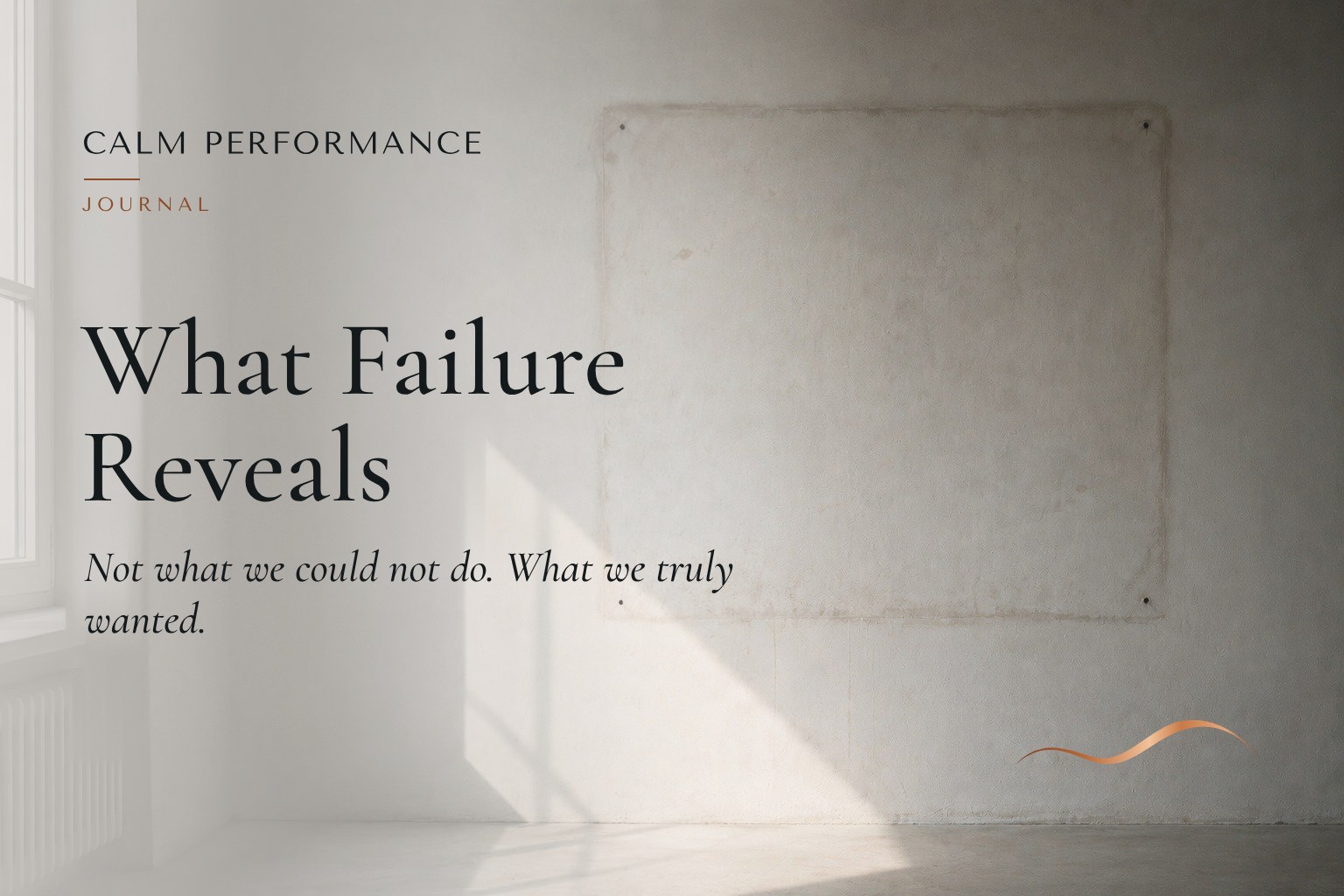
There is an empty room, with pale grey plaster walls and a concrete floor. A low light comes in from a window on the left, cutting across the wall and the floor in a clean diagonal. Beneath the window, an old radiator. Nothing else. No furniture, no people.
In the middle of the wall, though, there is something. A large rectangle, slightly paler than the rest of the plaster, edged with a thin line of dust, with four nails still driven into its corners. A painting hung there. Someone took it down. We do not know what it showed, what colours it had, why it was taken away. But we know its exact size.
It is strange how precise an absence can be. While the painting was on the wall, nobody could have told you how much space it took up. Now that it is gone, you can see it to the centimetre.
Some failures work the same way.
The shape of what is missing
We tend to think of failure as a void: the project that did not work, the application turned down, the relationship that did not last, the direction followed for years that turned out to be wrong. The natural response is to count what was lost. The time invested, the expectations disappointed, the distance between where we are and where we thought we would be by now.
But something else happens in that moment, and it gets far less attention. When something we have genuinely worked for fails, we discover, often for the first time with any precision, how much we wanted it. Not how much we said we wanted it, nor how much it seemed reasonable to want it. How much we really wanted it. Sometimes the two measures match. Sometimes they are far apart.
Anyone who has lost a job, a competition, a project they had given years to knows this moment. The first weeks are only for absorbing the blow. Then, almost without meaning to, you begin to notice what you actually miss. Sometimes it is the work itself, the daily practice, the people you did it with. Sometimes it is none of that, only the title, the way others looked at you, the picture you had of yourself. They are two very different kinds of loss, and only failure lets you tell them apart.
A failure that leaves real grief says that what was lost mattered, that the investment was real and the wanting was not just a habit or an expectation borrowed from someone else. A failure that leaves, beneath the first disappointment, a quiet relief says something just as important: that what we were chasing was not, in the end, what we wanted most. Part of us already knew. The failure simply made it audible.
Either way, like the rectangle on the wall, failure draws the outline of something. Not of what we could not do. Of what we wanted.
Silver and bronze
In 1995 three American psychologists, Victoria Medvec, Scott Madey and Thomas Gilovich, published a study that became famous. They had taken television footage of the 1992 Barcelona Olympics and asked a group of students to rate, on a scale of one to ten, how happy the athletes on the podium looked, both straight after their event and during the medal ceremony.
The result looked like a paradox. Bronze medallists appeared much happier than silver medallists. Immediately after the event, the silver medallists averaged 4.8 and the bronze medallists 7.1. Those who came second were thinking about the gold they had narrowly missed. Those who came third were thinking about fourth place, and the medal they had nearly gone home without.
The study is about how we measure ourselves against what might have happened. But it also says something about failure. Disappointment does not measure the result itself. It measures the distance between the result and what we were really aiming for. Second place is a failure only to someone who wanted to win. That is why the way an outcome hurts reveals, more honestly than anything we might say, where we were looking.
The near misses
In 2019 three researchers at Northwestern University, Yang Wang, Benjamin Jones and Dashun Wang, published an analysis in Nature Communications of 778,219 grant applications submitted between 1990 and 2005 to the US National Institutes of Health. They compared two groups of early-career scientists who were almost identical: 623 who had missed out on funding by a whisker, and 561 who had secured it by a whisker.
You would expect the second group, money in hand, to go further. That is not what happened. Over the next five years, 16.1 per cent of the papers written by those who had been turned down ended up among the most cited in their field, against 13.3 per cent for those who had been funded. The price was real, though: a single rejection raised the chance of leaving the NIH funding system over the following decade by 12.6 per cent. Some people, after that no, simply stopped.
The researchers tested the obvious explanations, and none was enough on its own. Their suggestion is that failure itself, for those who do not give up, makes them better. A rejected scientist is forced to ask, more precisely, what they are really looking for and why. Someone who scrapes through never has to ask.
The failure that teaches
Not every failure, of course, holds a lesson. Amy Edmondson, who teaches at Harvard Business School and has spent three decades studying how organisations learn from mistakes, draws careful distinctions in her 2023 book Right Kind of Wrong. There are basic failures, caused by carelessness, which are worth avoiding. There are complex failures, which grow out of many small causes adding up. And there are the ones she calls intelligent: they happen in new territory, in pursuit of a goal worth reaching, start from a reasoned hypothesis and are kept as small as possible.
Her own career began with a result that looked like a failure. In the 1990s, studying hospital wards, she expected to find that the best-led nursing teams made fewer errors. The data said the opposite: those teams recorded more. Only later did she understand why. They were not making more mistakes; they felt safe enough to report them. Out of that disproved hypothesis came the idea she is now known for, psychological safety.
These are the failures that reveal something. Not because they hurt less, but because they come from a real commitment to something not yet known. And because, if we look at them instead of filing them away in a hurry, they answer a question no success ever asks: was this what I wanted?
Success confirms a direction, but it does not tell us whether we chose that direction or simply inherited it. It closes the question before it can be examined. Failure opens it again, at exactly the moment we are most willing to look at it honestly.
The misfortune of never losing
Two thousand years ago Seneca wrote a short treatise, On Providence, in reply to a friend who wondered why bad things happen to good people. At one point he quotes the philosopher Demetrius: nothing seemed to him more unfortunate than a man to whom nothing adverse had ever happened. And he gives the reason: that man has never been allowed to put himself to the test.
Seneca knew what he was talking about. In AD 41 the emperor Claudius sent him into exile on Corsica, where he stayed for eight years, far from Rome, from his career, from almost everything he had built. It was there, on what was then a remote island, that he wrote some of his clearest pages, among them the consolation to his mother Helvia.
This is not praise of suffering. It is the observation that some kinds of knowledge come only at a price. Someone who has never failed at anything they cared about has not necessarily succeeded; perhaps they have never wanted anything enough to risk not getting it. Someone who has failed at something that mattered knows a thing about themselves that cannot be learned any other way: what it feels like to want something so much that its absence hurts.
That knowledge does not expire. It becomes part of the ground on which later decisions are made, not as a wound but as information. The next direction is chosen with more precision, because the last one was tested by reality and not only by imagination.
Before hanging another painting
At this journal, Calm Performance is our name for a way of working that judges performance partly by what it manages to preserve: energy, attention, clarity. Failure tests all three. And the most common response is also the most expensive one: filling the gap in a hurry, throwing ourselves straight into the next project, so as not to have to look at the wall.
A few simple choices follow. The first: after a failure, allow yourself some time before starting again, long enough to understand what you really feel. Grief and relief are different kinds of information, and they deserve a hearing before you decide anything. The second: ask what you would rebuild if you could, and what you find you have no wish to rebuild. The third: whenever possible, prefer small, intelligent failures, limited trials in new territory, to enormous bets that leave no room to learn.
And a fourth: do not confuse the result with the worth. Second place was not a defeat for someone who only wanted to reach the podium. The rejected application was not the end for those who carried on. What counts is what the failure tells us, and what we do with it.
The rectangle on the wall
Back to the empty room. The light has moved, and the diagonal on the floor now almost touches the wall. The pale rectangle is still there, with its four nails. Sooner or later someone will hang another painting, or repaint the wall, and the mark will disappear.
For now, though, it stays, and it says something precise. Not what is missing: that we already knew. It says how large the thing was that used to be there. And whoever looks long enough can decide whether the next painting should be the same size, or a different one, closer to what they truly want.
What failure reveals is not what we could not do. It is what we wanted. And that is often the most valuable thing to know.